Everything Traveloffsy publishes about Iceland, in one place. In 2025 July was its busiest month (17.3% of tourist nights) and December its quietest (3.9%). Below: weather pages, prices, holidays, entry rules, comparisons and officially recognised places, each linked to the page that cites the official source.
When to go
In 2025, July was Iceland's busiest month, with 17.3% of the year's tourist nights, and December the quietest, with 3.9%. If visitors were spread evenly, each month would carry 8.3%. These figures are from our Iceland page, which cites Eurostat.1
| Month | Share of 2025 nights | Compared with 8.3% |
|---|---|---|
| January | 3.9% | Below |
| February | 5.3% | Below |
| March | 6.2% | Below |
| April | 5.4% | Below |
| May | 6.6% | Below |
| June | 11.7% | Above |
| July | 17.3% | Above |
| August | 15.8% | Above |
| September | 11.0% | Above |
| October | 7.8% | Below |
| November | 4.9% | Below |
| December | 3.9% | Below |
Each month links to our page on where to go that month, which lists all 35 European countries we cover. A month's share describes 2025, not next year.
- When to visit Iceland to avoid crowds: tourist nights by monthMonth by month, who stays and how long
- Where to go by month: Europe and Japan
- Which European countries are most crowded in summer? 35 ranked
- Best-value month finder
- Are my dates busy?Check your own dates
- Trip plannerPlan each stop with your dates
Weather
Month-by-month weather pages for 2 cities in Iceland: averages for 1991 to 2020 at each city's weather station, with rain, rainy days and daylight. Averages, not a forecast.
The weather section of our Iceland page sets the station's averages next to the busy and quiet months.
Across all the places we cover: Weather and climate in Europe and Japan, Winter sun: the warmest cities in Europe and Japan and Driest month, wettest month and daylight, city by city.
Prices
Price level. In 2025, Eurostat's price level for restaurants and accommodation in Iceland was 173, about 73% above the EU average, and for all household spending 174, about 74% above the EU average. These figures are from our page Is Iceland expensive?, which cites Eurostat.2 They compare price levels between countries; they are not the cost of a trip.
Accommodation through the year. Over 2023 to 2025, Eurostat's accommodation price index for Iceland followed a clear yearly pattern: dearest in August (+21.4% against the year's trend), and cheapest in January (−11.1%). From our page Which months is accommodation dearest?, which cites Eurostat.3 The index shows how prices move through the year, not what you will pay.
Flights through the year. Over 2023 to 2025, Eurostat's air fares index for Iceland followed a clear yearly pattern: cheapest in January (−14.6%), and dearest in July (+23.8%). From our page Which months are flights cheapest?, which cites Eurostat.4 The index shows how prices move through the year, not what you will pay.
The air fares index is for flights that start in the country, by month of travel, as our air fares page explains.
More on money: Money and travel costs in Europe and Japan and When a card machine offers your home currency, what must it tell you?
Holidays
Public holidays. We do not publish a public holiday list for Iceland.
School holidays. We do not publish school holidays for Iceland.
All holidays month by month and check your own dates.
Entry, money and rules
- Schengen and the EU. Iceland is in the Schengen area but not in the EU. See which countries are in the Schengen area and the 90/180-day rule, or count your days with the Schengen calculator.5
- Currency. Iceland is not among the countries our euro page lists as using the euro.
- Phone roaming. EU “roam like at home” covers Iceland: in the European Economic Area, where the regime is also available. See where EU roaming stops.6
- Emergency number. Our sources do not say which number local services in Iceland expect. The Commission says 112 is available worldwide on GSM mobile networks. See our emergency numbers page.7
The items from our pre-trip checklist that apply to a trip to Iceland, each linked to the guide that sets out the rule and its official source:
Show the 14 checklist items
Entry and documents
- If you need no visa, count your days in the Schengen area against the 90/180-day rule. The EU 90/180-day rule for short stays, explained.
- Check which countries on your route are in the Schengen area. Which countries are in the Schengen area?
- Read what the Entry/Exit System and ETIAS mean for your trip. EES and ETIAS: what changes at Europe's borders.
Health and safety
- Check what your EHIC covers, if you have one, and what it does not. EHIC or travel insurance? What the card does not cover.
- Note the emergency numbers for the countries you are visiting. Emergency numbers: 112 in the EU, 110 and 119 in Japan.
Bags and customs
- Check the rules for power banks and liquids in your cabin bag. Power banks and liquids in cabin bags: 2026 rules.
- Check the duty-free allowances for what you will bring back. Duty-free allowances: EU and Japan side by side.
Money
- Check which countries on your route use the euro. Which countries use the euro in 2026?
- Decide in advance: pay in local currency or your home currency when a card machine asks. Pay in local currency or home currency? The EU rule.
Phone and time
- Check where EU roaming applies on your route, and where it stops. EU roaming: where 'roam like at home' stops.
- Check whether the clocks change during your trip. When do Europe's clocks change? EU summer-time rules.
If you drive
- Driving in Europe: check the alcohol limits and rules for each country. Driving in Europe: alcohol limits and rules by country. Iceland is not in that table: our page says Your Europe has no road-rules page for it.
If things go wrong
- Know your rights if a flight is delayed or cancelled. EU flight delay compensation in 2026, and the reform.
- Know your rights on trains, buses and ferries. EU train, coach and ferry delays: your rights.
Rules change. Each guide links the official page it is based on: check the current rule there before you travel. Make your own list with the trip checklist, or a card of the numbers with the emergency numbers card.
Compare
Iceland against its neighbours: when each is busy and quiet.
- Ireland or Iceland? When each is busy and when it is quiet
- Norway or Iceland? When each is busy and when it is quiet
- Sweden or Iceland? When each is busy and when it is quiet
City pairs: weather and crowds side by side.
Officially recognised places
The names and years are listed on our Iceland page, with the European Commission as source.
All of them on one page: officially recognised places.
More about Iceland
- How many days do visitors spend in each European country?
- Is it expensive? Price levels in Europe and Japan
See every country on our plan your trip page.
Cheat sheet for this page
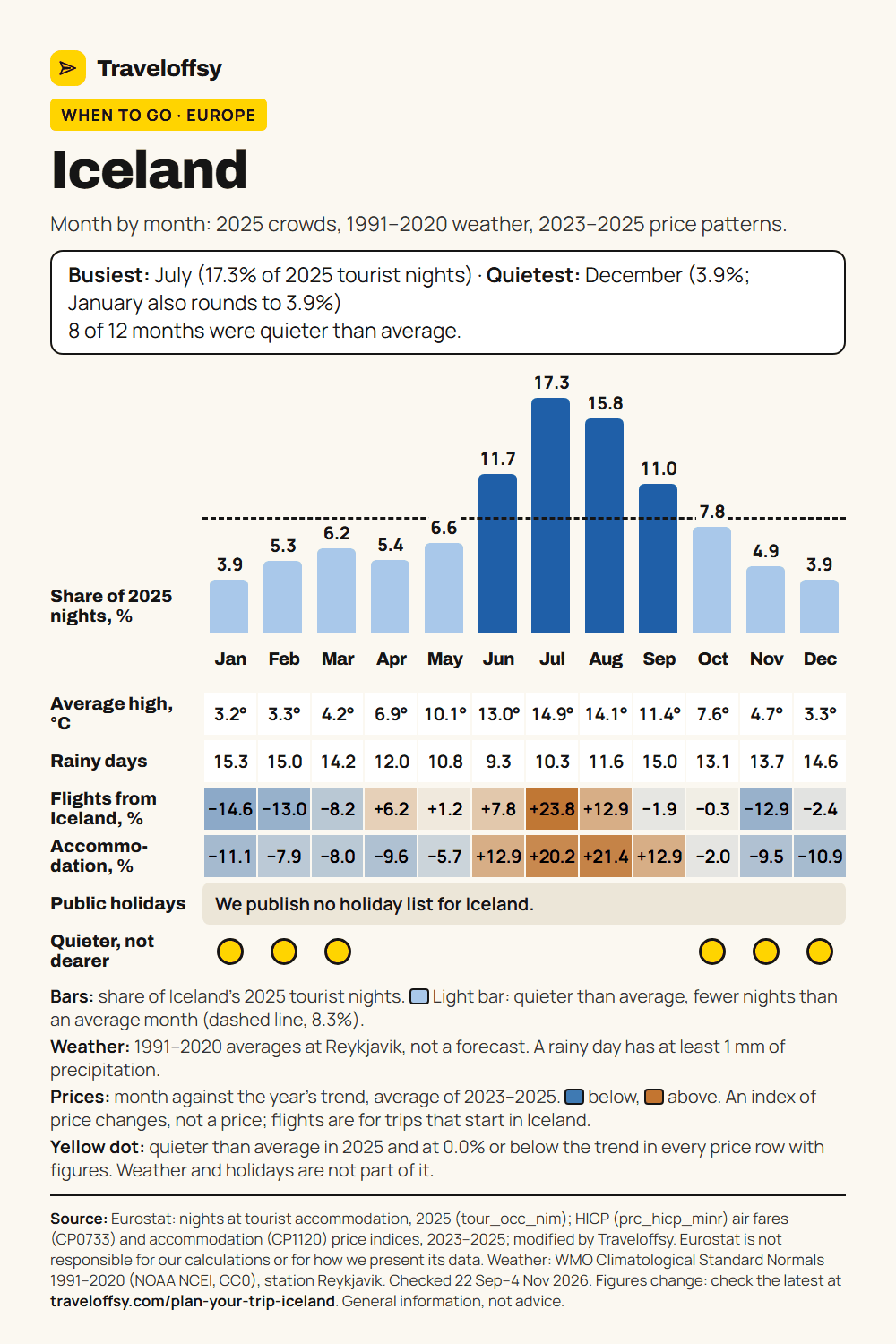
Source: Eurostat: nights at tourist accommodation, 2025 (tour_occ_nim); HICP (prc_hicp_minr) air fares (CP0733) and accommodation (CP1120) price indices, 2023–2025; modified by Traveloffsy. Eurostat is not responsible for our calculations or for how we present its data. Weather: WMO Climatological Standard Normals 1991–2020 (NOAA NCEI, CC0), station Reykjavik. Checked 22 Sep–4 Nov 2026.
Tall image (78 KB) Square image (54 KB) Printable PDF, A4 (162 KB)
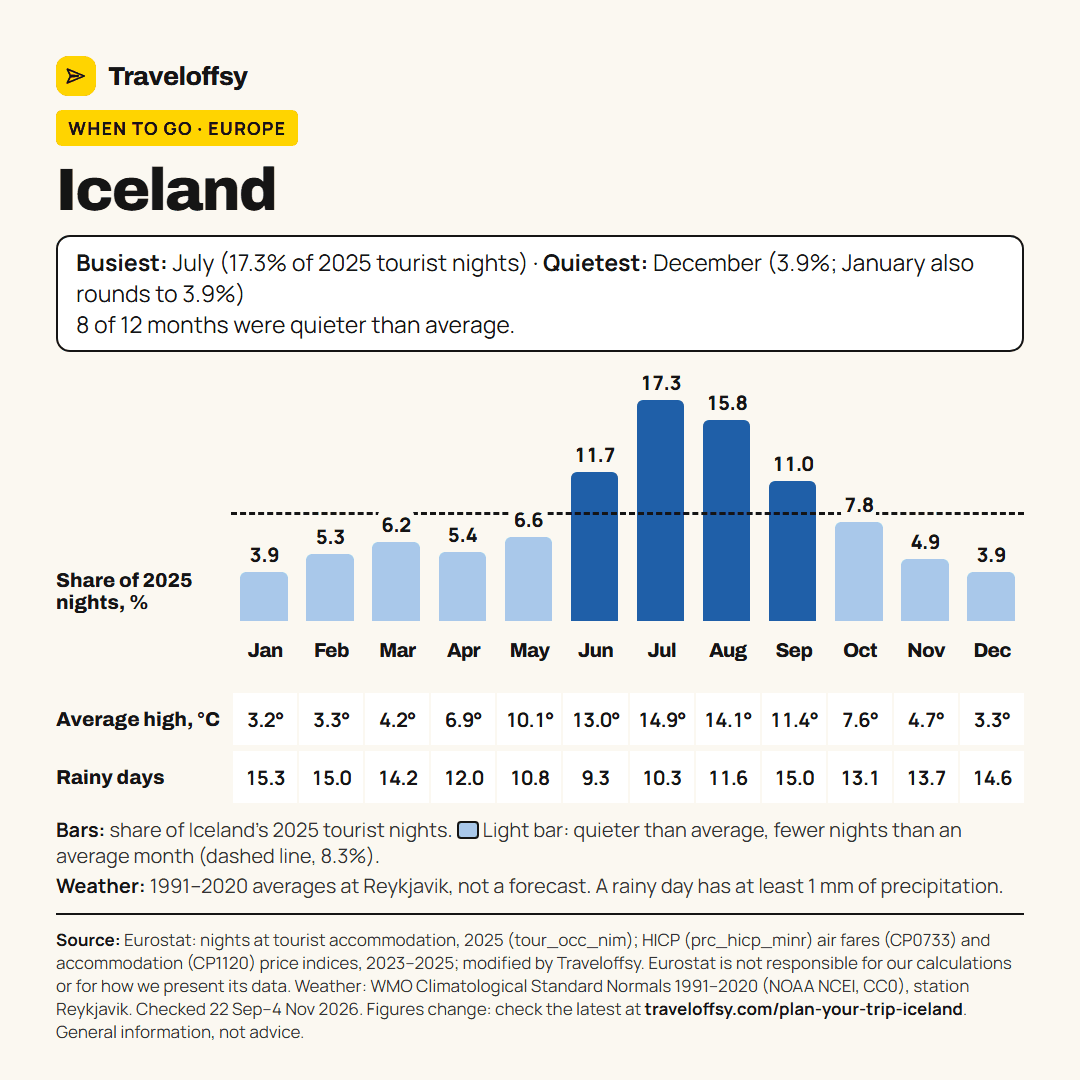
The page it comes from
Key takeaways
- July was Iceland's busiest month in 2025 and December its quietest.
- Every figure here is copied from one of our pages, which cites the official source.
- What we would skip: reading 2025's busy and quiet months as a forecast; check holidays and rules for your own dates.
Sources
Every figure here is copied from the linked page, which cites the official source below; the weather pages each cite their own station. See how we research.
- Source: Eurostat, Nights spent at tourist accommodation establishments – monthly data, doi:10.2908/TOUR_OCC_NIM, accessed 25 September 2026. Dataset last updated by Eurostat on 22 September 2026. Extract: number of nights, NACE codes I55.1–I55.3, all guests and split by guests resident in the country and abroad, January–December 2025.
- Price levels: Eurostat, Purchasing power parities, price level indices, nominal and real expenditures by analytical categories – based on COICOP 2018, doi:10.2908/PRC_PPP_IND_1, accessed 6 October 2026 (data updated by Eurostat on 9 July 2026). Extract: price level indices, EU27 (from 2020) = 100, 2025. Eurostat is not responsible for our calculations or for how we present its data.
- Accommodation price index: Eurostat, Harmonised index of consumer prices (HICP) – monthly data, doi:10.2908/PRC_HICP_MINR, accessed 6 October 2026 (data updated by Eurostat on 2 October 2026). Extract: accommodation services (CP1120), monthly index, July 2022 to June 2026. Eurostat is not responsible for our calculations or for how we present its data.
- Air fares price index: Eurostat, Harmonised index of consumer prices (HICP) – monthly data, doi:10.2908/PRC_HICP_MINR, accessed 4 November 2026 (data updated by Eurostat on 16 October 2026). Extract: passenger transport by air (CP0733), monthly index, July 2022 to June 2026. Eurostat is not responsible for our calculations or for how we present its data.
- European Commission, Migration and Home Affairs, Schengen area (page dated 27 May 2025). Read it. Accessed 5 October 2026. © European Union, licensed under CC BY 4.0; we summarised it.
- European Commission, Your Europe, Mobile roaming costs (page last checked by the Commission 7 January 2026). Read it. Accessed 24 September 2026. © European Union, licensed under CC BY 4.0; we summarised it.
- European Commission, Shaping Europe's digital future, 112 - the EU's emergency phone number (last update 23 June 2026). Read it. Accessed 24 September 2026. © European Union, licensed under CC BY 4.0; we summarised it.
We add no figures of our own: each number is copied from the data behind the page it links to, and the counts of holidays are counts of our own lists. Shares, price comparisons and month patterns are Traveloffsy calculations from Eurostat data, as the linked pages explain. Eurostat is not responsible for our calculations or for how we present its data.